
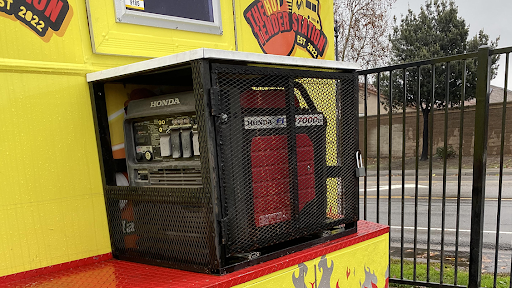
Understanding Your Power Needs
Before purchasing a generator, it’s essential to determine the total power consumption of your appliances. Each appliance has a power rating measured in watts (W), which indicates how much power it requires to operate. Here’s how to calculate your total power needs:
- List Your Appliances:
- Identify all the electrical appliances you will use in your food trailer, such as refrigerators, freezers, microwaves, coffee machines, lights, and ventilation systems.
Note: When you purchase a food trailer with Rollin’ Kitchens, this list is included so you don’t have to stress.
- Check Wattage:
- Look for the power rating label on each appliance. If it’s not listed in watts, you can calculate it using the formula: Watts = Volts x Amps.
- Add Up the Wattage:
- Sum the wattage of all appliances to determine your total power requirement. Add a 20-30% buffer to ensure your generator can handle the load without overloading.
Types of Generators
There are two main types of generators to consider: regular (conventional) generators and inverter (silent) generators.
- Regular (Conventional) Generators:
- Pros: Generally more affordable and provide higher power output.
- Cons: Noisier and less fuel-efficient.
- Average Cost: $1,000 – $3,000 depending on the wattage.
- Inverter (Silent) Generators:
- Pros: Quieter, more fuel-efficient, and produce cleaner power, making them suitable for sensitive electronics.
- Cons: Higher initial cost and usually offer lower power output compared to conventional generators of the same size.
- Average Cost: $2,000 – $5,000 depending on the wattage.
Types of Fuel in Generators
- Gasoline:
- Pros: Widely available, relatively inexpensive, and easy to store in portable containers.
- Cons: Short shelf life, highly flammable, and emits more pollutants compared to other fuels.
- Efficiency: Gasoline generators are generally less fuel-efficient compared to diesel and propane generators. They consume more fuel to produce the same amount of power.
- Diesel:
- Pros: More fuel-efficient and has a longer shelf life than gasoline. Diesel engines are durable and have higher torque, making them ideal for heavy-duty applications.
- Cons: Diesel is less available than gasoline in some areas, more expensive, and emits pollutants, though it burns cleaner than gasoline.
- Efficiency: Diesel generators are among the most fuel-efficient, using less fuel to produce the same amount of power compared to gasoline.
- Propane (LPG):
- Pros: Burns cleaner than gasoline and diesel, with lower emissions of pollutants. It has an indefinite shelf life and can be stored in large tanks.
- Cons: Propane generators tend to be less fuel-efficient than diesel. Propane tanks can be bulky and require proper storage.
- Efficiency: Propane is less efficient than diesel but more efficient than gasoline. It provides a good balance between efficiency and environmental impact.
- Natural Gas:
- Pros: Burns very cleanly, with low emissions. It’s convenient for stationary generators connected to a municipal supply.
- Cons: Not portable, as it requires a fixed pipeline connection. Availability can be limited in some areas.
- Efficiency: Similar to propane, natural gas is less efficient than diesel but more environmentally friendly.
- Dual-Fuel (Gasoline/Propane) and Tri-Fuel (Gasoline/Propane/Natural Gas):
- Pros: Flexibility in fuel choice, allowing users to switch between fuels based on availability and cost.
- Cons: Typically more expensive and complex to maintain. Efficiency varies based on the fuel used.
- Efficiency: Efficiency depends on the fuel being used. Propane and natural gas are cleaner but less efficient than diesel, while gasoline is less efficient than both.
Recommended Brands and Models
Based on reliability, performance, and customer reviews, here are some top generator brands and models to consider for food trailers requiring high power output with 50-amp inlets:
- Predator 9000 (Conventional Generator):
- Power Output: 9,000 watts (running), 11,500 watts (starting)
- Features: Electric start, large fuel tank, 50-amp RV outlet.
- Cost: Approximately $1,200
- Firman Tri-Fuel T07571 (Conventional Generator):
- Power Output: 7,500 watts (running), 9,400 watts (starting)
- Features: Tri-fuel capability (gasoline, propane, natural gas), electric start, 50-amp RV outlet.
- Cost: Approximately $1,300
- Champion 100111 (Conventional Generator):
- Power Output: 12,000 watts (running), 15,000 watts (starting)
- Features: Electric start, Intelligauge to monitor voltage, frequency, and operating hours, low-oil shutoff sensor, 50-amp RV outlet.
- Cost: Approximately $2,000
- Generac GP8000E (Inverter Generator):
- Power Output: 8,000 watts (running), 10,000 watts (starting)
- Features: Electric start, large fuel tank, 50-amp RV outlet.
- Cost: Approximately $1,300
Power Cord Length
The length of the power cord you need depends on the distance between your generator and your food trailer.
- Short Distance:
- For generators placed close to your food trailer, a 10-foot power cord is typically sufficient.
Note: Our company, Rollin Kitchens, gives you a free 10-foot power cord for the trailer when you leave us a review on social media.
- Medium to Long Distance:
- If your power source is further away, consider using a 25-foot or even a 100-foot power cord. Ensure the cord is heavy-duty and rated for outdoor use to handle the required power load without significant voltage drop.
- Choosing the Right Gauge:
- For shorter distances (10-25 feet), a 10-gauge cord is usually sufficient. For longer distances (50-100 feet), a thicker 8-gauge or even 6-gauge cord may be necessary to ensure safety and efficiency.
Final Thoughts
Choosing the right generator for your food trailer is crucial for ensuring smooth operation. By understanding your power needs, selecting the appropriate type of generator, and considering reputable brands and models with 50-amp inlets, you can make an informed decision that keeps your food trailer running efficiently. Remember, investing in a high-quality generator and the correct power cords can save you time, money, and headaches in the long run.